Remote work / the flexibility gap
Remote Accounting Jobs Statistics 2026: Telework Access vs. Fully Remote Hiring
Why telework can be common while fully remote vacancies remain scarce: BLS data, employer posting trends and an original sample of 237 accounting-related listings.
Remote accounting has a measurement problem. A job can allow some work from home without being advertised as fully remote. An existing employee’s arrangement also differs from the options offered to a new applicant. That distinction explains why two apparently conflicting statistics can both be useful.
We compare a national occupational requirements survey, a recruiter’s analysis of new postings and a dated sample from our board. Each answers a different question. None is a complete count of all remote accounting vacancies in the United States.
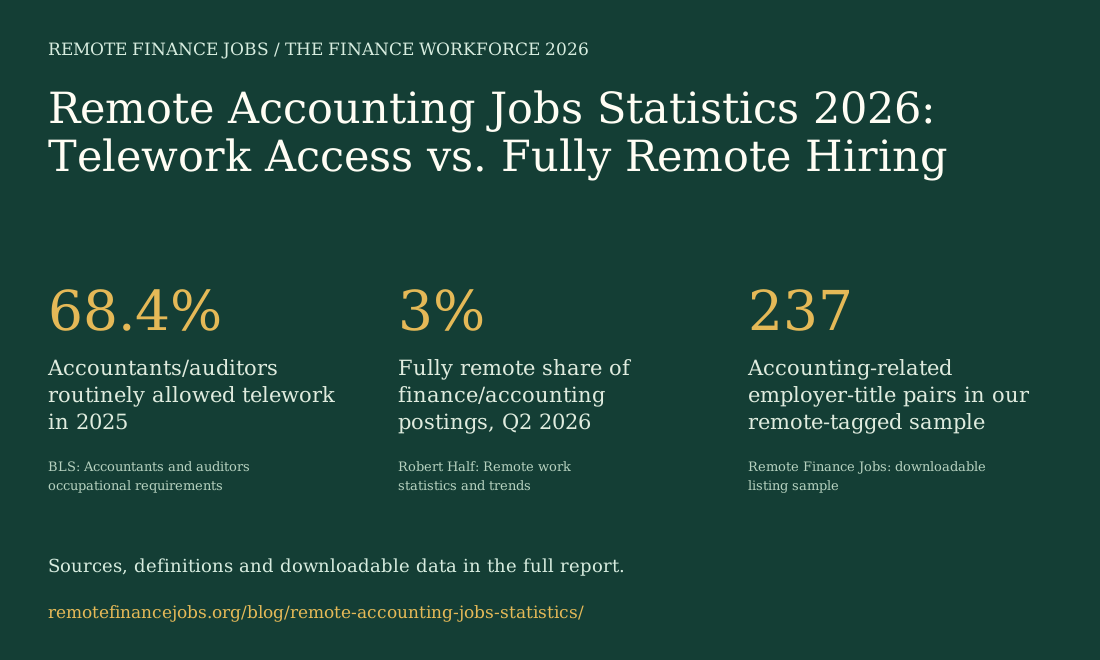
Telework access is not the same as a fully remote vacancy. The 68.4% and 3% figures describe different populations, periods and work arrangements; their difference is not a decline in remote accounting.
01 / THE DATA
What the 68.4% telework figure actually means
BLS reports routine telework access for 68.4% of accountants and auditors in 2025; 31.6% did not have it. The occupational profile also reports prior experience requirements for 70.7%, on-the-job training for 74.1% and a bachelor’s requirement for 91.3%. Source: BLS occupational requirements.
BLS defines telework around performing critical tasks at home for an agreed portion of the schedule. That includes arrangements that would not qualify as fully remote in a job search. Source: BLS definitions.
For candidates, ask about required office days and location eligibility before treating a role as work-from-anywhere. A broad statement that a profession permits telework does not resolve an individual employer’s policy.
| Occupational requirement | Share | Population / period |
|---|---|---|
| Routine telework allowed | 68.4% | Accountants/auditors, 2025 |
| Routine telework not allowed | 31.6% | Accountants/auditors, 2025 |
| Prior work experience required | 70.7% | Accountants/auditors, 2025 |
| On-the-job training required | 74.1% | Accountants/auditors, 2025 |
| Bachelor’s degree required | 91.3% | Accountants/auditors, 2025 |
02 / THE DATA
Fully remote vacancies are a narrower slice
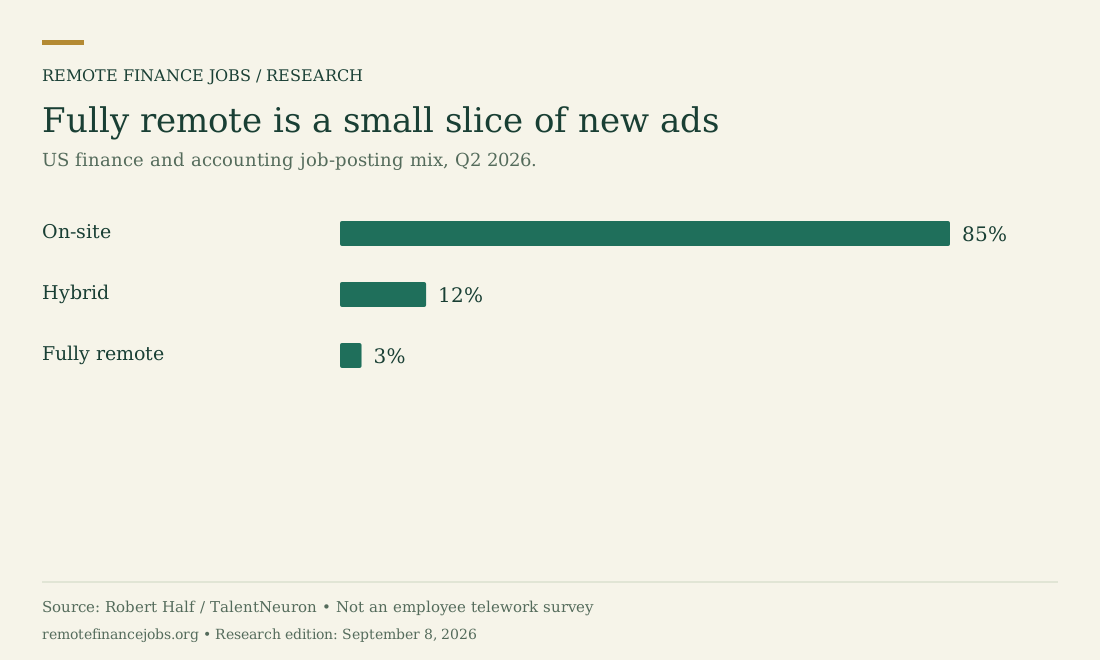
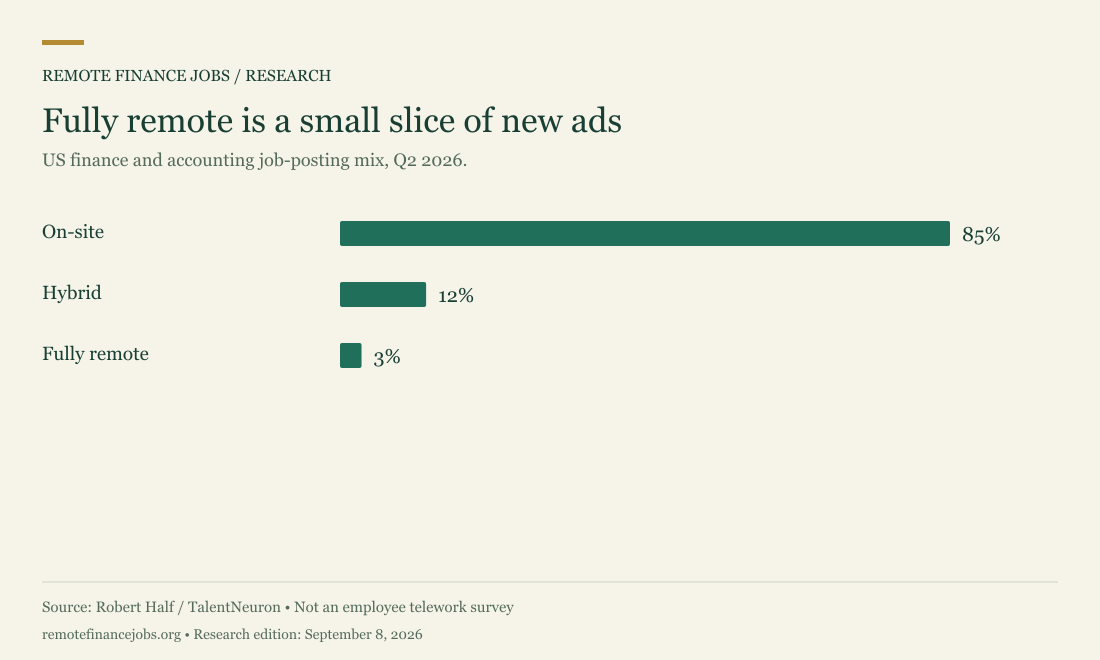
Robert Half’s Q2 2026 US finance/accounting posting mix is 85% on-site, 12% hybrid and 3% fully remote. It uses TalentNeuron postings grouped into the professional fields it supports. Source: remote-work trends.
The chart covers finance and accounting together, whereas the BLS telework measure covers accountants and auditors. It would be misleading to subtract these percentages or portray them as a time series. The useful conclusion is conceptual: flexibility in an established job and access to a new fully remote role are different things.
| Work arrangement | Share of postings | Reference period |
|---|---|---|
| Fully on-site | 85% | Q2 2026 |
| Hybrid | 12% | Q2 2026 |
| Fully remote | 3% | Q2 2026 |
03 / THE DATA
Inside our accounting-related listing sample
Our September 8 analysis identifies 237 accounting-related employer-title pairs across 224 normalized employers, drawn from the broader 1,051-posting US-listed, remote-tagged finance sample. Titles must contain accountant, accounting, controller or comptroller.
The subset includes controllers and senior accounting leadership. It excludes a bookkeeper whose title contains none of the selected terms. Our original dataset therefore offers a reproducible view of this board’s coverage, rather than a national estimate of the size or composition of remote accounting.
We collapse repeated employer-title pairs to reduce repeated and multi-location advertisements. That also can merge genuinely separate openings with identical titles. All retained records have a US location field, but that field alone does not establish whether the employer accepts applicants nationwide.
| Sample measure | Result | Definition |
|---|---|---|
| Accounting-related postings | 237 | Deduplicated employer-title pairs |
| Normalized employers | 224 | Within accounting-related subset |
| Share of broader finance sample | 22.5% | 237 / 1,051 |
| Usable annual salary ranges | 166 | Both bounds pass mechanical checks |
| Usable salary coverage | 70.0% | 166 / 237 |
| Missing or excluded salary ranges | 71 | 237 − 166 |
04 / THE DATA
Employment types: full-time dominates this sample
The source lists only full-time for 181 of the 237 accounting-related records. Another 39 lack an employment-type label. Some records list multiple arrangements, so we preserve those combinations rather than force a single classification.
This missing-data share matters when describing the market. A blank label does not establish part-time, contract or full-time status. Likewise, a listing with two labels does not necessarily represent two separate vacancies.
| Recorded employment-type label | Postings | Share of 237 |
|---|---|---|
| fulltime | 181 | 76.4% |
| Not specified | 39 | 16.5% |
| parttime | 7 | 3.0% |
| parttime, fulltime | 7 | 3.0% |
| fulltime, internship | 1 | 0.4% |
| temporary, parttime, fulltime, contract | 1 | 0.4% |
| parttime, contract | 1 | 0.4% |
05 / THE DATA
Accounting pay: a leadership-heavy sample
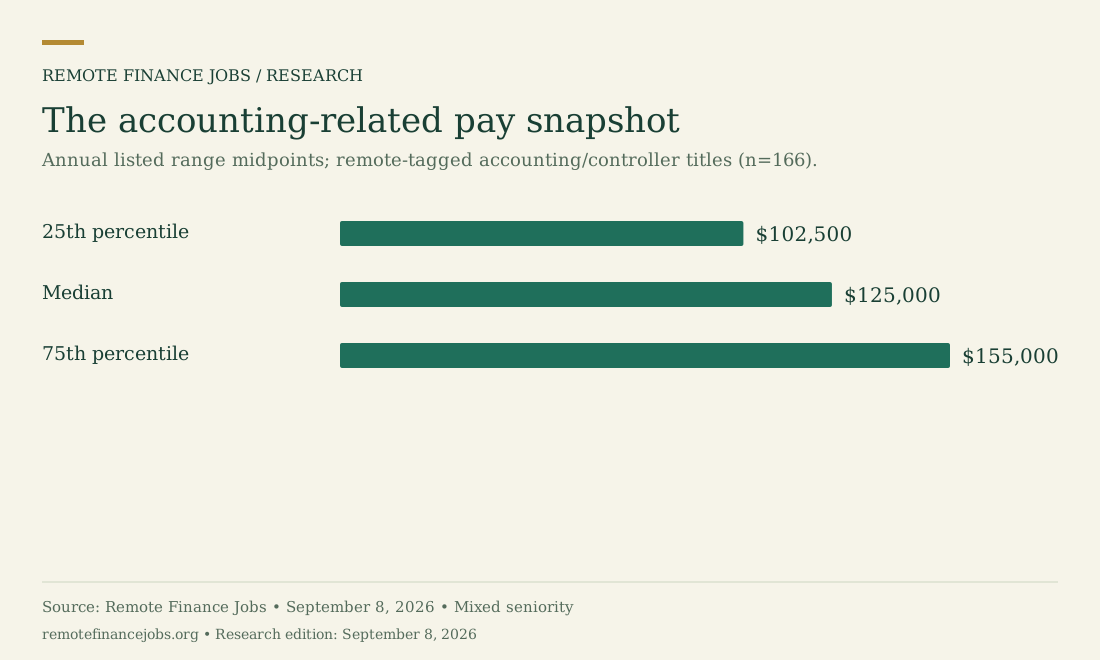
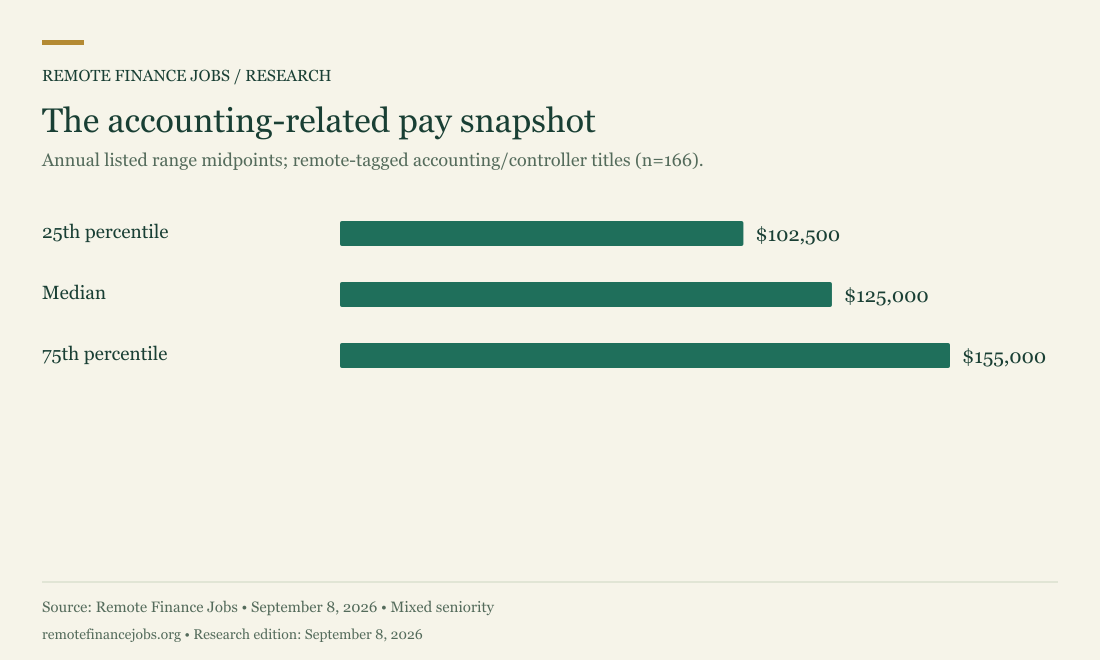
Among 166 usable salary ranges, the median midpoint is $125,000 and the middle half spans $102,500–$155,000. Of those ranges, 111 start at $100,000 or more and 142 reach that threshold at the upper end.
This should not be presented as the typical remote staff-accountant salary. The title rule includes controllers and directors, the source has selective coverage and only some postings provide usable pay. It also does not establish that working remotely causes higher compensation.
For a broader comparison by finance category and a detailed explanation of salary floors versus ceilings, see our remote finance salary statistics.
| Salary measure | Result | Basis |
|---|---|---|
| 25th percentile midpoint | $102,500 | 166 usable annual ranges |
| Median midpoint | $125,000 | 166 usable annual ranges |
| 75th percentile midpoint | $155,000 | 166 usable annual ranges |
| Range minimum ≥ $100,000 | 111 / 166 (66.9%) | Listed floor |
| Range maximum ≥ $100,000 | 142 / 166 (85.5%) | Listed ceiling |
06 / THE DATA
What these statistics mean for a job search
Separate three questions before applying: does the role allow home working, does it require office attendance, and where may the employee live? None can be answered reliably from a salary number or a job-board location label alone.
Also compare duties before comparing compensation. A controller managing a close process and an early-career accountant are not interchangeable observations just because both appear in a remote accounting search. The strongest comparison matches responsibility, seniority, geography and pay definition.
The accountant shortage report explains the talent pipeline, and the finance market report covers national demand. To investigate individual opportunities, browse the current job board and check each original employer listing for the work arrangement and pay terms.
RESEARCH NOTES
Methodology & reuse
This report was researched on September 8, 2026. Dates beside statistics identify the observation or forecast period; “2026” in the title is the publication edition. National occupational data cover all work arrangements. Employer surveys describe respondents, and projected openings are not a count of currently unfilled jobs.
You may reuse charts created by Remote Finance Jobs with a link to this article. Keep source credits, dates and population labels attached. Downloadable CSV files reproduce the article tables; follow their source links for the underlying publishers’ definitions. We have not conducted an independent national employer survey.
The original analysis starts with 1,457 local listing records collected from Indeed and last seen September 8, 2026. We retain new/active records seen within 14 days, dated no more than 90 days earlier where a posting date exists, marked remote, with a US location ending “, US”, and matching the board’s finance-title relevance rules. This leaves 1,374 records. Deduplicating normalized employer plus title removes 323 repeated records and leaves 1,051 employer-title pairs. The first retained record supplies location and pay; distinct same-title vacancies can therefore be merged.
“Remote-tagged” means the source record flags the listing as remote. It is not an independent verification of fully remote eligibility: hybrid work, office attendance or geographic restrictions may appear in the description. This convenience sample reflects the board’s search coverage, not the entire US labor market. All records come from one platform; no market-wide remote share, trend or causal pay premium is estimated.
Salary calculations use the existing annualized minimum and maximum fields for US listings, interpreted in USD. Eligible ranges have a minimum of at least $20,000, maximum no greater than $500,000, maximum at least the minimum, and maximum/minimum no greater than 3. Missing and excluded ranges are not zero salaries. These mechanical checks do not verify every original pay period, bonus component or employer estimate. Medians describe listed range midpoints, not employee earnings or accepted offers. Quartiles use linear interpolation; dollars are rounded for display.
Categories are the source pipeline’s primary labels and can contain classification errors. Category salary summaries require at least 20 eligible ranges. The accounting subset uses titles containing accountant, accounting, controller or comptroller. This includes senior leadership and excludes bookkeepers without those title terms; it is not a representative staff-accountant sample. Download the row-level sample and inclusion flags to inspect or reproduce the calculations.
Suggested citation: Remote Finance Jobs Research. “Remote Accounting Jobs Statistics 2026: Telework Access vs. Fully Remote Hiring.” September 8, 2026. https://remotefinancejobs.org/blog/remote-accounting-jobs-statistics/
Sources & reference periods
- BLS: Accountants and auditors occupational requirements ↗2025 Occupational Requirements Survey · Accessed September 8, 2026
- BLS: Occupational Requirements Survey definitions ↗2025 occupational profiles and definitions · Accessed September 8, 2026
- Robert Half: Remote work statistics and trends ↗Q2 2026 US job-posting analysis using TalentNeuron · Accessed September 8, 2026
- Remote Finance Jobs: downloadable listing sample ↗September 8, 2026; US-listed, remote-tagged, deduplicated Indeed sample · Accessed September 8, 2026