Accounting talent / supply & demand
Accountant Shortage Statistics 2026: The Pipeline Is Turning, the Pressure Isn’t
Accounting graduates, CPA candidates, hiring pressure and the enrollment rebound—source-linked data explaining why the accountant shortage is more complicated than one headline.
The accountant shortage has two timelines: employers need experienced people now, while a recovering student pipeline takes years to reach the workplace. Looking at only graduation declines misses the rebound; looking at only enrollment growth misses the current hiring problem.
This briefing separates education, professional entry and employer demand. It focuses on the United States and uses original publishers wherever possible. There is no defensible single “number of missing accountants” in these sources, so we report the indicators rather than manufacture a national shortage total.
The pipeline is improving before the staffing problem is solved. Enrollment growth is an encouraging leading indicator; it is not a count of qualified accountants available to hire today.
01 / THE DATA
The graduate pipeline: a smaller graduating class
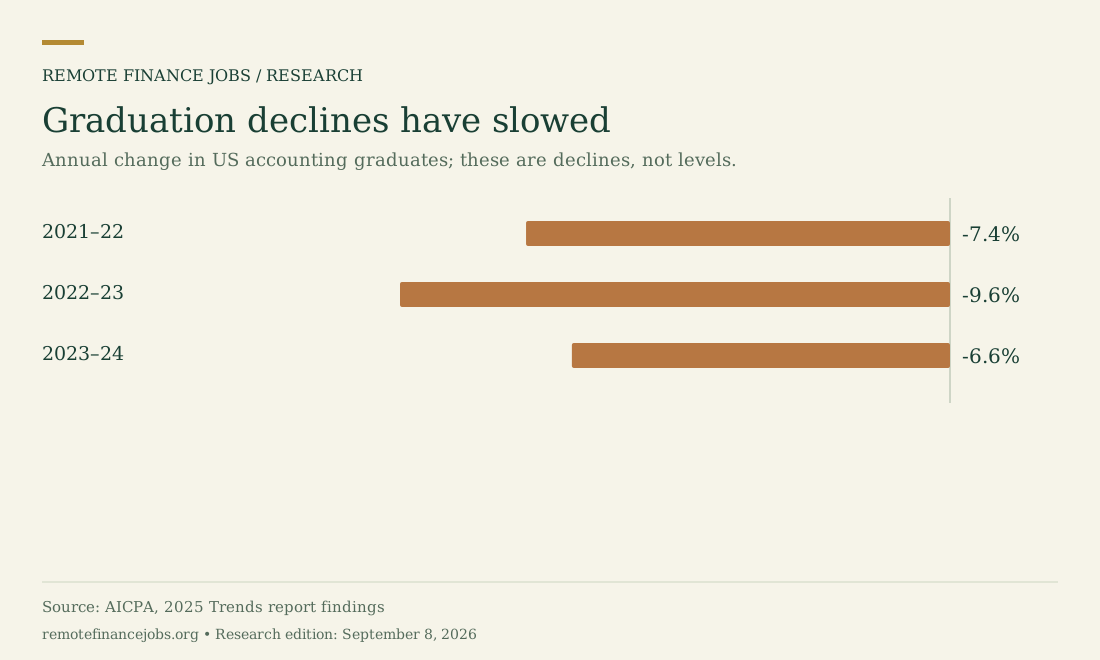
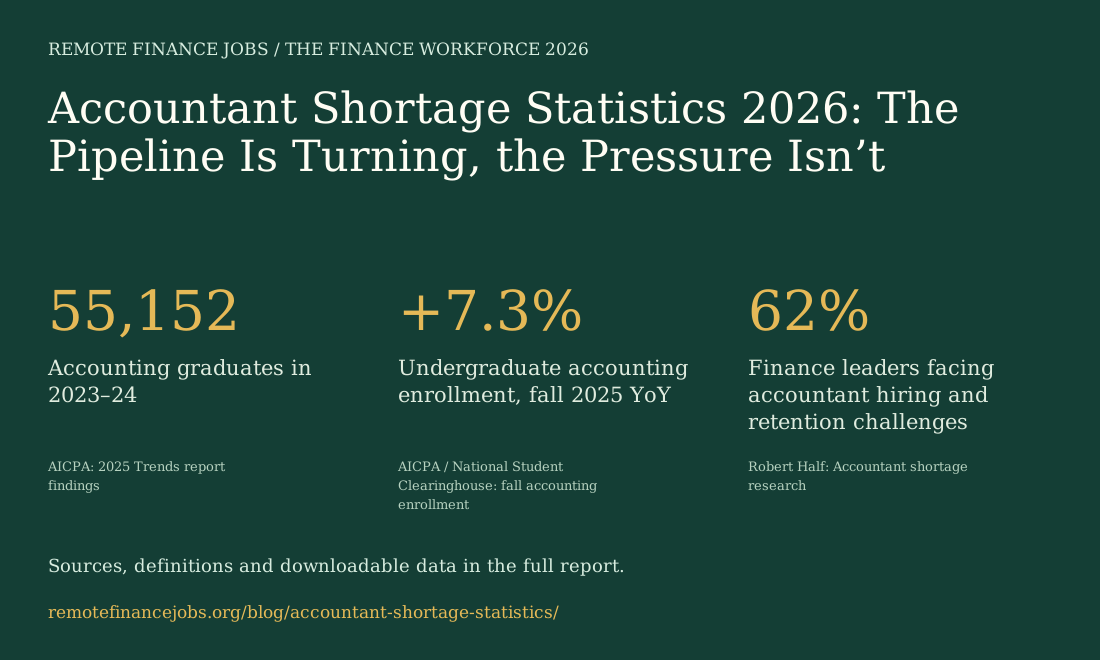
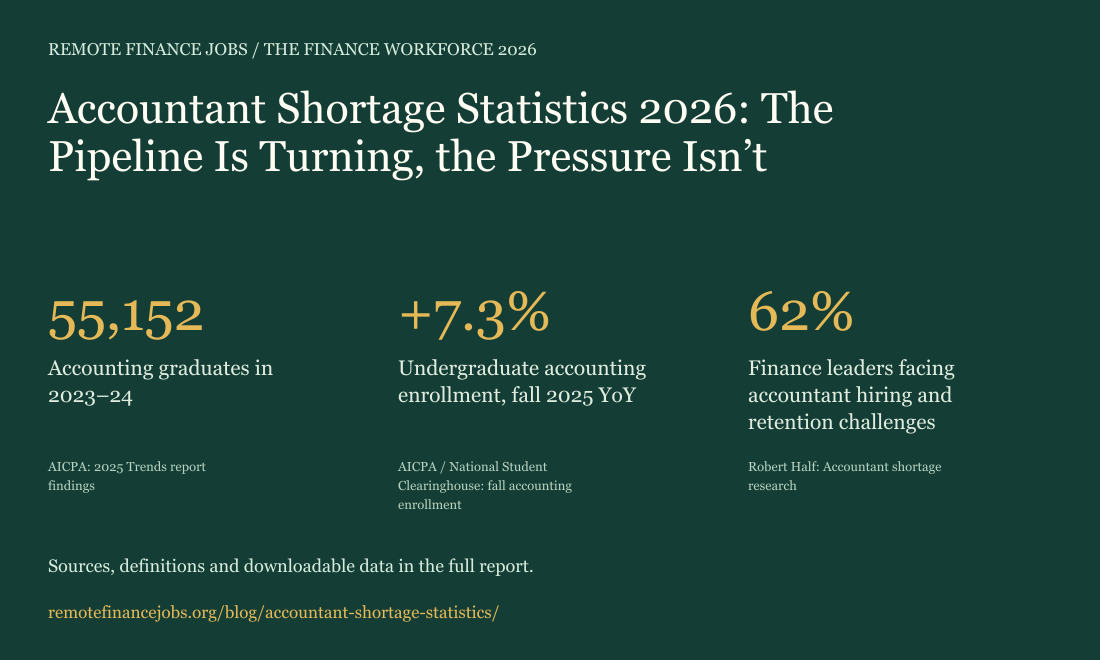
The AICPA’s 2025 Trends findings put 2023–24 accounting graduates at 55,152, down 6.6%. Bachelor’s graduates numbered 40,817; master’s graduates in accounting or taxation numbered 14,335. Their respective declines were 3.3% and approximately 15%.
The postgraduate decline matters for how employers build candidate pools, but these degree counts do not map one-to-one to unique entrants to accounting employment. A person can earn more than one degree, and a graduate can choose a different career.
| Measure | Value | Period |
|---|---|---|
| Accounting graduates | 55,152 | 2023–24 |
| Bachelor’s graduates | 40,817 | 2023–24 |
| Master’s graduates | 14,335 | 2023–24 |
| All accounting graduate change | −6.6% | 2023–24 YoY |
| Previous annual decline | −9.6% | 2022–23 |
| Earlier annual decline | −7.4% | 2021–22 |
02 / THE DATA
The rebound starts before graduation
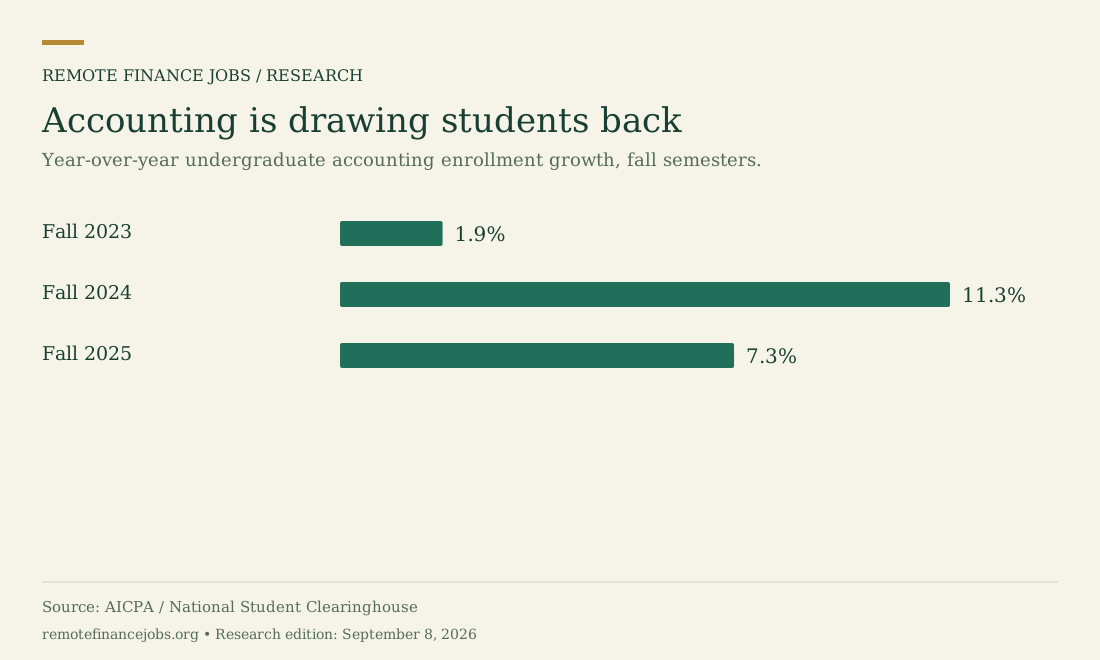
Fall undergraduate accounting enrollment rose 7.3% in 2025, following increases of 11.3% in 2024 and 1.9% in 2023. All-major undergraduate enrollment grew 1.2% in fall 2025. Source: AICPA / National Student Clearinghouse.
Spring 2025 provides a separate checkpoint: undergraduate accounting enrollment reached 266,507, up 12%, or 29,312 students. Do not join the spring and fall totals into a single series: their timing and reported populations differ. Source: spring enrollment release.
The useful reporting angle is the lag. Employers recruiting this quarter cannot assume that enrollment gains will immediately replenish experienced staff. Retention and training remain separate questions from student interest.
| Enrollment indicator | Reported value | Scope |
|---|---|---|
| Fall 2023 annual growth | 1.9% | Undergraduate accounting |
| Fall 2024 annual growth | 11.3% | Undergraduate accounting |
| Fall 2025 annual growth | 7.3% | Undergraduate accounting |
| Fall 2025 total | 313,397 | All postsecondary accounting |
| Fall 2024 total | 293,759 | All postsecondary accounting |
| Four-year undergraduate total | 204,283 | Fall 2025 accounting |
| Graduate enrollment | 25,580 | Fall 2025 accounting |
| Share of business undergraduates | 1 in 8 | Fall 2025 accounting majors |
03 / THE DATA
CPA candidate counts need an exam-change footnote
New CPA Exam candidates fell from 42,626 in 2023 to 28,082 in 2024; 16,448 entered in the first half of 2025. A new exam model began in 2024, following a pre-change surge. Source: AICPA.
These are new candidates, not newly licensed CPAs. A six-month count also should not be compared directly with a full-year count or mechanically doubled into a forecast. For a journalist, the exam redesign belongs in the same sentence as any year-to-year comparison.
04 / THE DATA
What hiring pressure actually measures
Robert Half reports that 62% of finance and accounting leaders face difficulty hiring and retaining accountants. Its salary-guide research also finds 87% typically offer higher pay for specialized expertise. Source: accountant shortage research.
Separately, 61% say skilled hiring is harder than a year earlier, while 74% plan permanent headcount growth and 63% plan more contract hiring in the second half of 2026. These measures refer to finance and accounting leaders, not just public accounting firms. Source: hiring trends.
A survey can identify hiring friction without proving every accountant has multiple offers. Specialty, experience, compensation and location can all separate employer demand from the candidates currently applying.
| Indicator | Result | Interpretation |
|---|---|---|
| Accountant hiring / retention challenges | 62% | Survey finding; not an unfilled-job rate |
| Pay premium for specialist skills | 87% | Share of finance leaders; not premium size |
| Skilled hiring harder year over year | 61% | Finance/accounting leaders |
| Plan permanent headcount growth | 74% | Second half of 2026 |
| Plan increased contract hiring | 63% | Second half of 2026 |
05 / THE DATA
Annual openings are not a shortage estimate
BLS projects 115,300 annual accountant/auditor openings over 2025–2035, with employment rising 5%, or 79,400 jobs across the decade. Source: BLS occupational outlook.
Annual openings include replacement needs. Subtracting the graduating class from openings would mix different populations and periods: experienced workers, occupational transfers and nontraditional entrants also participate in hiring. The difference is not a valid national “shortfall.”
For remote hiring, the practical question is narrower: how many suitable roles offer the arrangement candidates need? Our remote accounting jobs report compares telework access with new remote listings, while the finance job market report puts accounting beside other occupations.
RESEARCH NOTES
Methodology & reuse
This report was researched on September 8, 2026. Dates beside statistics identify the observation or forecast period; “2026” in the title is the publication edition. National occupational data cover all work arrangements. Employer surveys describe respondents, and projected openings are not a count of currently unfilled jobs.
You may reuse charts created by Remote Finance Jobs with a link to this article. Keep source credits, dates and population labels attached. Downloadable CSV files reproduce the article tables; follow their source links for the underlying publishers’ definitions. We have not conducted an independent national employer survey.
Enrollment counts, degrees, exam candidates and employed accountants are different units. Do not sum them or infer a shortage by subtraction. The fall enrollment release’s header is dated January 20, 2026; its body contains a January 2025 dateline inconsistency. The figures are explicitly labeled fall 2025.
Suggested citation: Remote Finance Jobs Research. “Accountant Shortage Statistics 2026: The Pipeline Is Turning, the Pressure Isn’t.” September 8, 2026. https://remotefinancejobs.org/blog/accountant-shortage-statistics/
Sources & reference periods
- AICPA: 2025 Trends report findings ↗2023–24 education; 2024 hiring and CPA candidates; 2025 hiring intentions · Accessed September 8, 2026
- AICPA / National Student Clearinghouse: fall accounting enrollment ↗Fall 2023–2025; published January 20, 2026 · Accessed September 8, 2026
- AICPA: spring accounting enrollment ↗Spring 2025 undergraduate enrollment · Accessed September 8, 2026
- Robert Half: Accountant shortage research ↗2026 salary guide and Demand for Skilled Talent research · Accessed September 8, 2026
- Robert Half: Finance and accounting hiring trends ↗Second-half 2026 hiring intentions · Accessed September 8, 2026
- BLS: Accountants and auditors ↗May 2025 wages; 2025–2035 projections; updated August 27, 2026 · Accessed September 8, 2026